Commercial Plumbing Requirements for Sydney Businesses
The health inspector's visit started routine. Then she walked into the kitchen of a busy Sutherland Shire café and noticed water pooling near the grease trap. The trap hadn't been cleaned in eight months — well beyond the required quarterly maintenance. The café received a violation notice and 48 hours to fix it or face closure.
The emergency service call, grease trap pumping and compliance documentation cost $2,400. The reputational damage from the violation notice? Harder to quantify. The owner told us later: "I didn't even know grease traps needed quarterly cleaning. I thought annual was enough."
Commercial plumbing operates under stricter regulations, higher usage demands and greater consequences than residential. A blocked drain at home is inconvenient — a blocked drain during lunch rush costs revenue, damages reputation and may force closure. This guide covers what every Sydney business owner needs to know: regulatory requirements, industry-specific needs, maintenance programs, emergency planning and compliance documentation.
Commercial vs Residential Plumbing: Key Differences
Scale, Codes & Usage
A home toilet flushes 15 times daily — a restaurant toilet, 100+ times. Commercial fixtures must be professional-grade. Where residential plumbing meets the basic building code, commercial must comply with the Building Code of Australia, AS/NZS 3500, council requirements, health department standards, DDA accessibility rules and industry-specific codes. Non-compliance means fines, closure orders and liability exposure.
Maintenance frequency reflects this: residential annual servicing is adequate, commercial requires quarterly minimum — monthly for high-use facilities.
Business Disruption Costs
A residential failure is an inconvenience. A commercial failure means lost revenue from forced closure, staff sent home (labour cost with no revenue), customer complaints, potential health violations and spoiled inventory. A blocked drain during Friday dinner service can cost $5,000+ in revenue plus reputation damage.
Specialised Equipment
Commercial-specific plumbing includes grease traps, high-capacity hot water systems, commercial dishwashers, multi-stall bathroom facilities, floor drains and drainage systems, mandatory backflow prevention devices, and industrial washing machines.
Industry-Specific Plumbing Requirements
Hospitality & Restaurants
Grease traps are mandatory for all food businesses. Sizing is calculated by a plumber based on kitchen fixtures and food volume. Cleaning is required quarterly minimum (monthly for busy kitchens), with records maintained for inspection. Installation runs $2,000–$6,000 and cleaning $300–$600 each time.
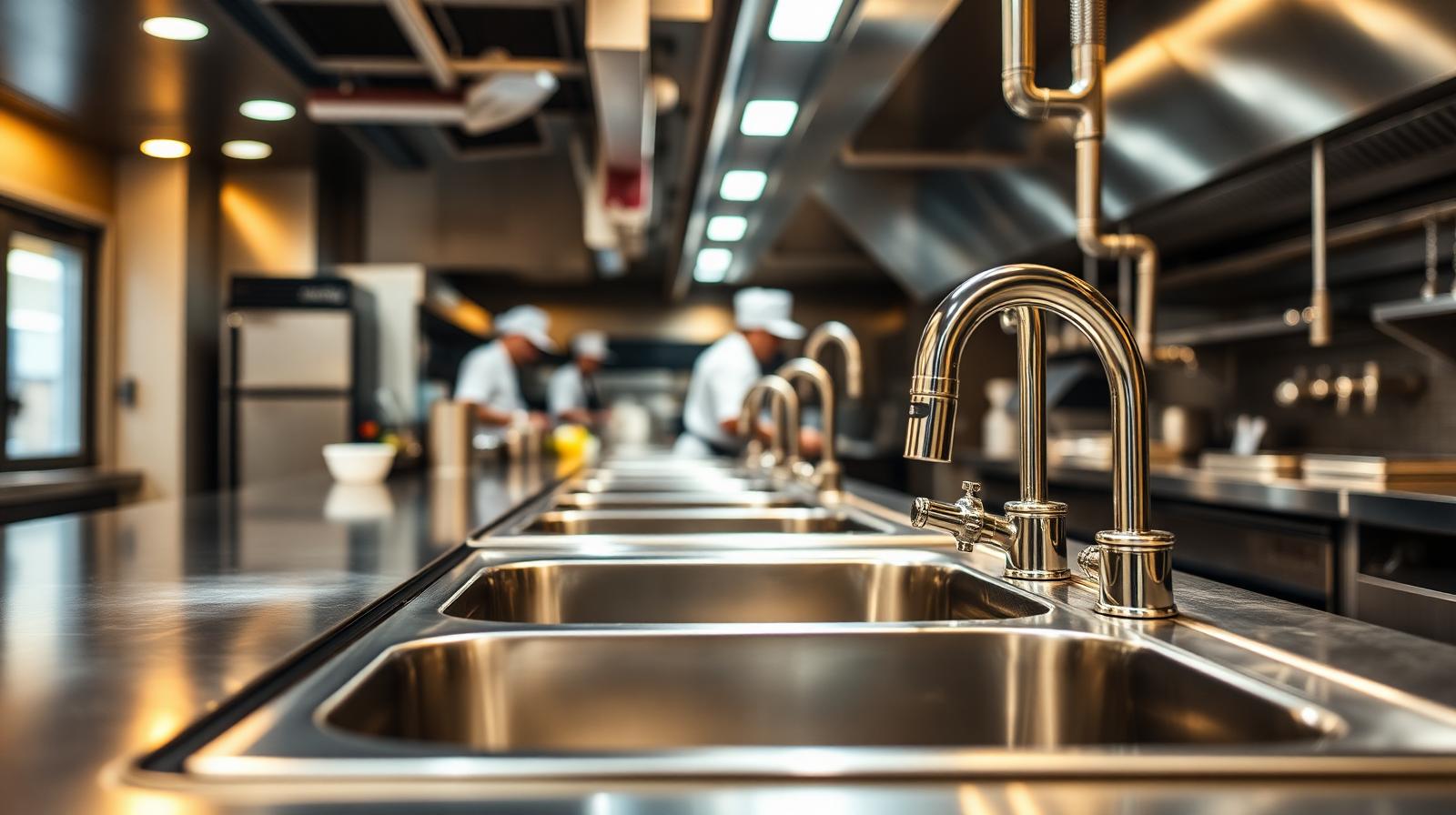
Commercial kitchen plumbing requires a 3-compartment sink to health-code spec, dedicated hand-washing stations with hot and cold water, commercial dishwasher connections with adequate hot water and backflow prevention, and floor drains that handle daily wash-down cleaning.
Gas fitting for commercial ranges, ovens and fryers requires professional installation and annual safety inspections — see our gas fittings page.
Compliance checkpoints: health department inspections (quarterly–annually), council grease trap compliance, fire safety on gas connections, annual backflow prevention testing.
Gyms & Fitness Centres
20–50+ showers used daily with peak demand after work hours create constant hair and soap-scum buildup and high hot water demand. Requirements include commercial-grade water-efficient shower heads, drainage capacity for simultaneous showers, commercial hair traps and DDA-compliant accessible facilities.
Locker room floor drains must not back up at peak. Commercial laundry connections handle continuous towel loads. Pool/spa plumbing (if applicable) requires specialised filtration knowledge.
Retail & Commercial Spaces
Staff amenities require minimum toilet counts based on staff numbers and DDA-compliant accessibility. Customer washrooms have higher fixture counts, mandatory accessibility, often family facilities and require relentless maintenance — public perception is critical. Even basic food prep (coffee, sandwiches) triggers hand-washing and drainage requirements, and may require a grease trap if cooking is involved.
Office Buildings
Multi-floor plumbing complexity includes pressure management between upper and lower floors, riser pipes serving multiple floors, and coordinated repair scheduling across tenants. Emergency fixtures (eyewash stations, emergency showers) require regular testing and maintenance. Strata properties add coordination between building manager and tenant responsibilities.
Commercial Plumbing Compliance
Building Codes & Standards
AS/NZS 3500 governs plumbing and drainage design, installation, materials and testing. The Building Code of Australia (BCA) sets minimum fixture counts, accessibility, sanitary facilities and water efficiency. Local councils enforce development applications, compliance certificates, trade waste agreements (commercial kitchens) and inspection protocols.
Health Department Standards
Food businesses must comply with detailed standards on hand-washing facilities (type, location, number), food prep sinks (sizing, separation), commercial dishwashing, grease trap installation and maintenance, hot water temperature and floor drainage. Inspections run quarterly to annually depending on risk rating — violations can result in closure orders.
Accessibility (DDA)
Disability Discrimination Act compliance requires accessible toilet facilities (design, fixtures, spacing), grab rails in specific positions, wheelchair-accessible sink and tap heights, ambulant facilities additional to accessible, and signage. New builds and renovations must meet current standards; existing buildings must make reasonable adjustments.
Backflow Prevention (Mandatory)
Backflow is contaminated water flowing back into the drinking supply. Commercial properties — with chemical storage, irrigation systems, grease traps and industrial processes — face higher contamination risk. Requirements: backflow prevention devices installed, annual testing by a licensed plumber, results submitted to the water authority. Non-compliance risks water disconnection. Cost: $180–$350 annually.
Grease Trap & Hot Water Compliance
Grease traps require quarterly minimum cleaning by a licensed waste contractor with documentation including installation compliance certificate, quarterly cleaning invoices and waste manifest records. Council can request these anytime.
Hot water must be stored at 60°C+ to prevent Legionella, tempered at outlets to prevent scalding, with regular testing required. Commercial systems must be sized for peak demand and serviced annually under AS/NZS 3500.4.
Commercial Plumbing Maintenance Programs
Why Maintenance Matters More for Businesses
Prevents downtime: scheduled maintenance during closed hours prevents mid-service failures. Maintains compliance: grease trap, backflow and documentation always inspection-ready. Reduces emergency costs: emergency commercial rates run $400–$1,200, lost revenue $1,000–$10,000+, and rush repairs cost 2–3× regular rates. Protects reputation: no customer complaints, no public-record violations. Extends equipment life: commercial fixtures are expensive — regular maintenance doubles lifespan.
Preventive Services
Quarterly scheduled inspections of all fixtures and drainage; preventive drain maintenance with annual hydro jetting on high-use lines and grease trap areas; proactive fixture work (washers, flush mechanisms, leaks); annual hot water service with temperature, pressure and efficiency testing; annual backflow testing with compliance submission; quarterly grease trap servicing with proper waste disposal documentation.
Maintenance Program Tiers
- Bronze — $150/month: Quarterly inspections, same-day priority response, 10% repair discount, compliance documentation. Best for small retail and professional offices.
- Silver — $350/month: Bi-monthly inspections, same-day response guarantee, $500/year of included minor repairs, grease trap cleaning arranged, backflow testing included, after-hours availability. Best for cafés, restaurants, boutique gyms and high-traffic retail.
- Gold — $650/month: Monthly inspections, 4-hour emergency response, $2,000/year of included repairs, after-hours work at no premium, all compliance testing, monthly reporting, dedicated account manager. Best for large restaurants, major gyms, commercial buildings and multi-location businesses.
- Custom Enterprise: Tailored service levels, multi-site coordination, dedicated team, 24/7 priority response, comprehensive compliance management, budget planning.
ROI: Medium-Sized Restaurant
Without a program (annual costs): emergency blocked drains 2× yearly $1,200 + lost revenue from closures $3,000 + health violation fine $1,500 + emergency grease trap $800 + rush hot water repair $1,200 = $7,700.
With Silver Program ($4,200/year): no emergency blockages, no closures, no violations, grease trap on schedule, hot water serviced before failure, minor repairs included, ~$500 in additional repairs = $4,700.
Savings: $3,000 annually — plus eliminated stress, protected reputation and compliance confidence.
Emergency Commercial Plumbing
Common Commercial Emergencies
Restaurant/Café: grease trap overflow (closure-level health hazard), kitchen drain blockage, no hot water (dishwasher inoperable), customer-facing toilet backup, gas leak.
Gym/Fitness: multiple shower drains blocked at peak, no hot water, locker room toilet overflow, pool pump failure.
Office: floor flooding (computer equipment risk), no water to building, sewage backup requiring evacuation.
Retail: customer bathroom out of order, visible leaks, floor flooding (slip hazard, closure).
Business Impact
Forced closure from health violations, safety issues or inoperable critical systems. Revenue loss: lunch rush $2,000–$5,000, dinner service $3,000–$8,000, full day $5,000–$15,000+, weekend 2–3×. Reputation damage: social media complaints, review site mentions, lost regular customers.
Easy Solutions Emergency Response
24/7 commercial priority line with 2–4 hour typical response, after-hours/weekend/holiday coverage. We work during closed hours when possible, perform sectional repairs to keep parts of the business open, and arrive in fully-stocked commercial vehicles. Our team understands business pressures, knows health code requirements, works efficiently and presents professionally for customer-facing environments. See our 24/7 emergency plumber service.
After-Hours & Scheduled Commercial Work
After-hours work avoids business disruption, eliminates revenue loss and maintains professional image. Available scheduling: evenings after closing, overnight (start after close, finish before opening), weekends and public holidays.
Industry examples: restaurants — between lunch and dinner service, after close 10pm–11pm, Mondays. Gyms — overnight midnight–5am, early morning, off-peak 2pm–4pm. Offices — evenings after 6pm, weekends. Retail — after close, Sundays, early morning.
Choosing a Commercial Plumber
Commercial Experience is Essential
Not all plumbers understand commercial — the faster pace required, business impact awareness, compliance knowledge and customer-facing professional appearance. Look for a documented commercial portfolio, industry-specific experience, named references and demonstrated compliance knowledge.
Licensing & Insurance
Higher stakes require a verified plumbing license, gas fitting license (if applicable), $20 million minimum public liability, professional indemnity insurance and WorkCover for employees. Higher coverage matters because of potential business losses, customer injury risk and large-scale damage potential.
Compliance Knowledge & Availability
Your commercial plumber must understand health codes, building codes, council requirements, DDA accessibility and backflow requirements — and provide compliance certificates, testing records and as-built documentation. Essential service capability: 24/7 emergency access, 2–4 hour response, after-hours and weekend availability, plus account management with a single point of contact.
Easy Solutions Commercial Services
Trusted by Sydney businesses including EMF Gyms (multiple locations), Crust Cronulla, Liquorland (multiple stores), Grind Café and Youthworks.
Full commercial services: Bronze to Enterprise maintenance programs · 24/7 emergency response with 2–4 hour typical arrival · after-hours work · complete compliance documentation · multi-location coordinated support · account invoicing terms.
Why businesses choose Easy Solutions: NSW Plumbing License 290333C, gas fitting qualified, $20M public liability, professional indemnity, 11+ years' commercial experience across diverse business types, deep compliance expertise (health codes, grease traps, backflow testing, documentation) and reliable same-day response.
Conclusion
Commercial plumbing is essential business infrastructure. Proper maintenance, compliance management and emergency preparedness protect revenue, reputation and regulatory standing.
Key actions: schedule a compliance audit (grease trap, backflow, health code); implement a preventive maintenance program; establish an emergency response plan; document all services for inspection records; budget for proactive maintenance instead of reactive emergencies. Don't forget the basics — see our guide to preventing blocked drains.
Need a licensed plumber today?
Call Sutherland Shire's trusted licensed plumbers for honest advice and transparent quotes.
Call 0423 233 322
About the Author
Grace Hamilton writes for Easy Solutions Plumbing and Gas, providing expert plumbing advice for Sutherland Shire and Sydney homeowners. All technical information is reviewed by licensed plumbers to ensure accuracy.